

Key Takeaways
- A CBCT scan is a type of dental imaging that creates detailed 3D images of your jawbone, teeth, nerves, and the surrounding structures.
- Dental CBCT scans help periodontists evaluate bone loss, plan dental implant placement, and identify issues that might not be visible on traditional dental X-rays.
- CBCT scans are generally safe when they are medically needed, although they do involve more radiation exposure than standard dental X-rays.
- The cost of a CBCT scan varies depending on the provider and the area being scanned. Some dental insurance plans in Utah may cover the procedure when it’s considered necessary for treatment.
If your periodontist has recommended a CBCT scan, you might be wondering what it is and if it’s really necessary. In this guide, we’ll go over how CBCT scans work, what they’re used for, how much they cost, and what to expect before, during, and after your appointment. We have offices in Salt Lake City and the surrounding areas, conveniently located near Draper, Lehi, and Midvale.
What is a CBCT Scan?
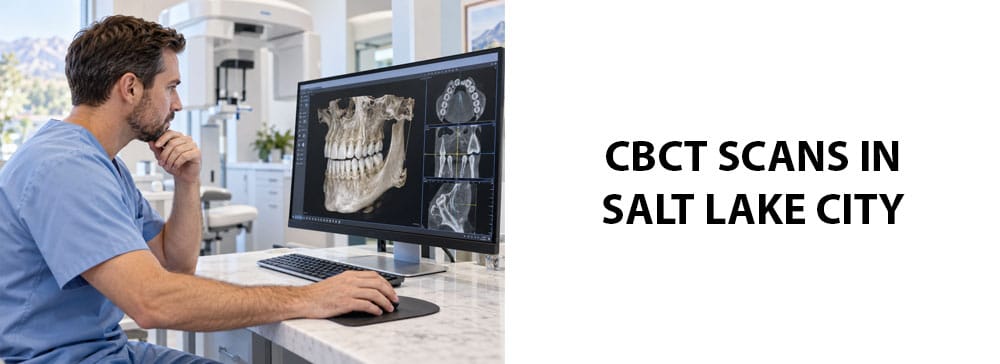
A CBCT scan, short for cone-beam computed tomography, is a type of dental imaging that creates detailed 3D pictures of your teeth, jawbone, and surrounding structures. Unlike traditional dental X-rays, which provide flat, two-dimensional images, a CBCT scan lets your periodontist examine your mouth from multiple angles.
What Is It Used For?
Periodontists use CBCT scans when they need a closer look at something that isn’t fully visible on a regular dental X-ray. The detailed 3D images can be especially helpful when planning certain procedures or evaluating more complex dental problems. Below is a list of some of the most common reasons a periodontist might recommend a CBCT scan:
- Dental implant planning: Checking the height, width, and density of your jawbone to determine the best location for an implant.
- Evaluating bone loss: Getting a better look at bone damage caused by advanced gum disease and identifying areas that might need treatment.
- Planning bone grafts: Determining whether you have enough healthy bone to support an implant or whether a bone graft might be necessary.
- Examining complex dental problems: Identifying certain issues involving tooth roots, impacted teeth, or surrounding structures that can be difficult to assess with standard X-rays.
- Assessing nearby anatomy: Locating important structures, such as nerves and sinus cavities, before performing certain periodontal or implant procedures.
Keep in mind that not every patient needs a CBCT scan. Your periodontist will generally recommend one when the extra detail could help with your diagnosis or treatment plan.
How Much Does it Cost to Get a CBCT Scan in Salt Lake?
If you’re getting a CBCT scan in the Salt Lake City area, you can generally expect to pay somewhere between $150 and $400. This is a rough estimate, and some scans might cost more. This pricing is for general dental imaging rather than a confirmed quote from a SLC provider. The actual cost will depend on where you go, how much of your mouth needs to be scanned, and whether the imaging is part of a larger treatment plan.
For example, a scan focusing on one small area might cost less than one that captures your entire jaw. Some periodontal offices also include CBCT imaging in their dental implant consultation or treatment fees, so it’s worth asking what’s included before scheduling.
Dental insurance might also cover part of the costs in certain situations, but coverage can vary quite a bit between plans. If your periodontist recommends a CBCT scan, ask their office for an estimate and whether they can help you check your insurance benefit ahead of time.
How to Prepare for a CBCT Scan?
There’s really not much prep involved for a CBCT scan. You can basically eat, drink, and take your regular medications beforehand, and there’s no need to change your normal routine.
The one thing to keep in mind is that metal objects can interfere with the imaging. You’ll more than likely be asked to remove any jewelry, glasses, hair accessories, or removable dental appliances that could get in the way. Be sure to let your periodontist know if you’re pregnant or think you might be pregnant so they can determine whether the scan is appropriate.
How Does the CBCT Scan Work?
CBCT technology uses a cone-shaped X-ray beam to capture images of your teeth, bones, and surrounding tissues. As the machine moves around your head, it collects hundreds of individual images that a computer combines into a detailed 3D model. This allows your periodontist to look at your mouth from different perspectives, zoom in on certain structures, and take very precise measurements.
How is a CBCT Scan Performed?
When it’s time for your scan, a dental team member will help you get into the correct position, either sitting or standing, depending on the machine. You might be asked to rest your chin on a support or gently bite down on a small positioning guide to help keep your head steady.
Once you’re in place, the scanner will rotate around your head while you remain as still as possible. You won’t feel anything during the scan, and there won’t be any anesthesia or needles involved.
The actual imaging usually only takes under a minute to complete. Your dental team will let you know when it’s finished, and you can step away from the machine.
What to Expect Before and After
Before your scan, your periodontist will go over why it’s needed and answer any questions you might have. After the scan, you can return to your normal activities right away with no recovery time needed.
Who Interprets the Results and How to Get Them
Your periodontist will review your CBCT images to look for any concerns and then determine the next steps in your treatment. In some cases, a dental radiologist might also review the scan. Your periodontist may go over the results with you during the same appointment or schedule a follow-up visit to go over findings and any recommended treatments. If you’d like a copy of your results, you can request the images and any available reports from the dental office.
What Are the Benefits and Risks of a CBCT Scan?
Like any type of medical imaging, a CBCT scan comes with a few things to consider and be aware of. Here’s a closer look at the advantages and potential risks.
Benefits of a CBCT Scan
- Detailed 3D images: Provides a clearer view of your teeth, jawbone, and surrounding structures than traditional dental X-rays.
- More precise treatment planning: Helps your periodontist plan dental implants, bone grafts, and other procedures with greater accuracy.
- Better detection of certain problems: Can reveal bone loss and other issues that might be difficult to see on regular dental X-rays.
- Quick and painless: The scan typically takes less than a minute and doesn’t require needles or anesthesia.
- Noninvasive: There’s no surgery or recovery time involved.
Risks of a CBCT Scan
- Radiation exposure: CBCT scans generally expose you to more radiation than standard dental X-rays, although the amount varies depending on the machine and scan settings.
- Not recommended for everyone: Pregnant patients and children might need additional precautions because of radiation exposure.
- Possible incidental findings: The detailed images might reveal unrelated abnormalities that require additional evaluation or testing.
- Higher cost: CBCT scans typically cost more than traditional dental X-rays and might not be fully covered by insurance.
Get a Clearer Picture of Your Oral Health
Having the right information can make all the difference when it comes to your oral health. A CBCT scan is just one of the tools that helps your periodontist understand your needs and recommend treatment with confidence.
At Utah Periodontal Specialists, we believe you should always feel comfortable asking questions and understanding your options. Our team takes the time to explain what we’re seeing, walk you through our recommendations, and make sure you feel good about your care. It’s that personal attention, along with our commitment to quality periodontal treatment, that keeps patients coming back.
If you have questions about CBCT scans or need periodontal care, contact our team at Utah Periodontal Specialists. We’d be happy to help you take the next step.
FAQs
How is a CBCT scan different from a regular dental X-ray?
A regular dental X-ray produces a flat, 2D image, while a CBCT scan creates a detailed 3D view of your teeth, jawbone, and surrounding structures.
Is a CBCT scan safe?
Yes, CBCT scans are generally considered safe when they’re medically necessary. CBCT scans do involve radiation exposure, typically more than regular dental X-rays but less than conventional medical CT scans. Your periodontist will only recommend one when they feel the additional information is worth the exposure.
Does dental insurance in Utah cover a CBCT scan?
Some dental insurance plans in Utah cover CBCT scans when they’re considered medically or dentally necessary, especially for certain surgical procedures. However, coverage varies by provider and plan, and some policies exclude 3D imaging altogether. It’s always a good idea to check your specific insurance benefits before scheduling a scan.
Do you need a CBCT scan before getting dental implants?
A CBCT scan is generally recommended when planning dental implant placement. The detailed 3D images help your periodontist evaluate your jawbone and locate nearby nerves and sinuses before surgery. This allows for more precise implant planning and helps reduce potential complications.
Recent Comments